Disclaimer: About This Blog

THIS BLOG IS: my personal journey of how I am rethinking some of my spiritual beliefs.
THIS BLOG IS NOT: intended to point fingers at people who I think are wrong.
I do not believe the final judgement will be based on how many correct answers we get on a theology exam. I believe many people throughout history have had genuine relationships with God, despite holding questionable beliefs and practices. I make no claim to having it all figured out or being your judge. If we end up disagreeing over these topics I pray we can find a way to demonstrate grace.
Showing posts with label church unity. Show all posts

Friday, September 26, 2014

Truce


"... a time for war and a time for peace." Ecclesiastes 3:8

I'm not a huge fan of war in real life.  I pray I never have to participate in one. The ideal world would be one where there is no war, always peace. But I recognize dreaming of our world without war may be just a dream. I also recognize that many of the freedoms we enjoy today are a result of battles fought by others before my time.

The same applies to the wars in Christ's church that have divided and reformed over the years. I also dream of a day when the Church would recognize that it is one, and that there would be peace. The prayer for Christian unity was the starting point of my journey that got me blogging 6 years ago.  However throughout the history of the church many battles have been fought.  I recognize that some of those battles have brought new understandings of the freedom and life Christ is offering us.

But I'm not a huge fan of war.

I believe aspects of my blog has been more than pushing forward different fronts in different battles.  For myself it has largely been a tool I have used to process different beliefs.  Sorting through beliefs and traditions that have been handed down to me, testing them against Scripture, and looking at alternative ways of interpreting Scripture related to that topic.  I enjoy theological dialogues. I enjoy gaining fresh perspectives of how Scripture can be interpreted.  I enjoy grappling through issues that have polarized the church, and trying to find balance within the tensions.  I enjoy the teaching one another that can sometimes occur in on-line discussions.

But I understand I am in the minority here.  I get that most people do not welcome questions that challenge beliefs they hold to.  So my pushing and questioning here naturally creates an equal and opposite reaction from others.

I still believe the Church is entering another reformation. Some of the changes I feel are taking place:
  • A fresh awareness what the priesthood of all believers under Christ is
  • An increased desire to follow the person of Jesus (less desire to follow a religion about Jesus)
  • An increased understanding that there is only one Church even though it meets in different places
  • A new emphasis on relational and participatory gatherings
I pray that at the end of the day Christ's people reflect more of the love and grace of Christ's that we all proclaim.

However at this point I am questioning if my little contributions to the cause are worth it.

My default is for the way of peace.   I do not enjoy tension. I do not like mis-trust. I do not enjoy causing pain, or receiving pain.  These all come in varying degrees whenever we engage in any sort of conflict or debate.  I've known and accepted this all along.  But I sense it may be time to wave the white flag of truce.

I've likely written enough here on this blog.  If someone wants to openly dialogue or discuss any of these topics they can contact me or find others who are also engaged in such discussions.

Related Posts:

Monday, July 14, 2014

Christian Unity Observations


About 8 years ago this passage of John 17:20-23 got me going on a journey. This is the only recorded prayer from Jesus for us, those who believe in Him through the testimony of the first disciples. Yet here we are now with over 30,000 denominations, sects, and divisions. Unity can seem hard to imagine. Over the past 8 years I have enjoyed studying some Church history, the reasons behind some of the divisions, and we have tried to visit and dialogue with Christians from a number of different denominations.

Here are some of the things I have discovered:
  • Unity is an essential of the faith. Some people create different lists of essential beliefs, and then find a level of unity with people who agree to the same items on their lists.  However we can not ignore the volume of Scripture on the topic of unity (see link for some verses).  Unity with all Christians should be near the top of those lists, even if there is disagreement around some of the other items. 
  • Before creating or maintaining a division on a specific topic we should ask this question: "is there more clear Scriptural teaching backing my position than there is clear Scriptural teaching on unity and love?"
  • We can respond to disagreements with love and humility.
  • Unity doesn't always mean we agree on everything, but it may mean we bear with one another in love. Consider how family dynamics often work. Being part of a family doesn't usually hinge on agreement on everything.
  • Pushing conformity often results in the opposite of unity. Some people may conform to your way of thinking, but divisions and walls will be created with others.
  • Insisting you are right can be wrong if it is not done in love.
  • I find recognizing church unity easiest when I recognize that church is people gathering together.  We don't have to pray that denominations all merge into one. We can recognize and live out church unity whenever we get together with other believers.
  • There is one church, and it meets in many different places and times.
Unity isn't achieved with our own effort:
"so that the love you have loved me with may be in them, and I may be in them.”

I'd love to hear your thoughts. 

Friday, February 7, 2014

That Was Easy


I want to emphasize some easy to understand principles of following Jesus.

Sometimes the walk is tougher than the talk.  But I'm afraid sometimes the talk is more complicated than it needs to be.

As I've sorted through some stuff that has hurt my brain, I have come to some clarity on some simple thoughts.


Easy to understand essential beliefs:


Trust in Jesus


Easy to understand how we should live:

Love God and love others.


Easy to understand how we do that:

The Holy Spirit does the work of the Holy Spirit.


Easy to understand disciple making:

See one, do one, teach one.


Easy to understand leadership:

Demonstrating to others how to follow.

Easy to understand church:

Get together with other followers to encourage each other to follow Jesus.


Easy to understand church unity:


There is one church, it meets in many different places and times.


I'm simply organizing some simple thoughts on what I think it means to follow Jesus.

I'm not claiming that living in this reality is easy.

I'd love to hear your thoughts? Have I missed any big ones?
.

Here are some less easy to understand related posts if you want to understand the more complex process I took to come to a place of seeing things so simply:

Tuesday, January 21, 2014

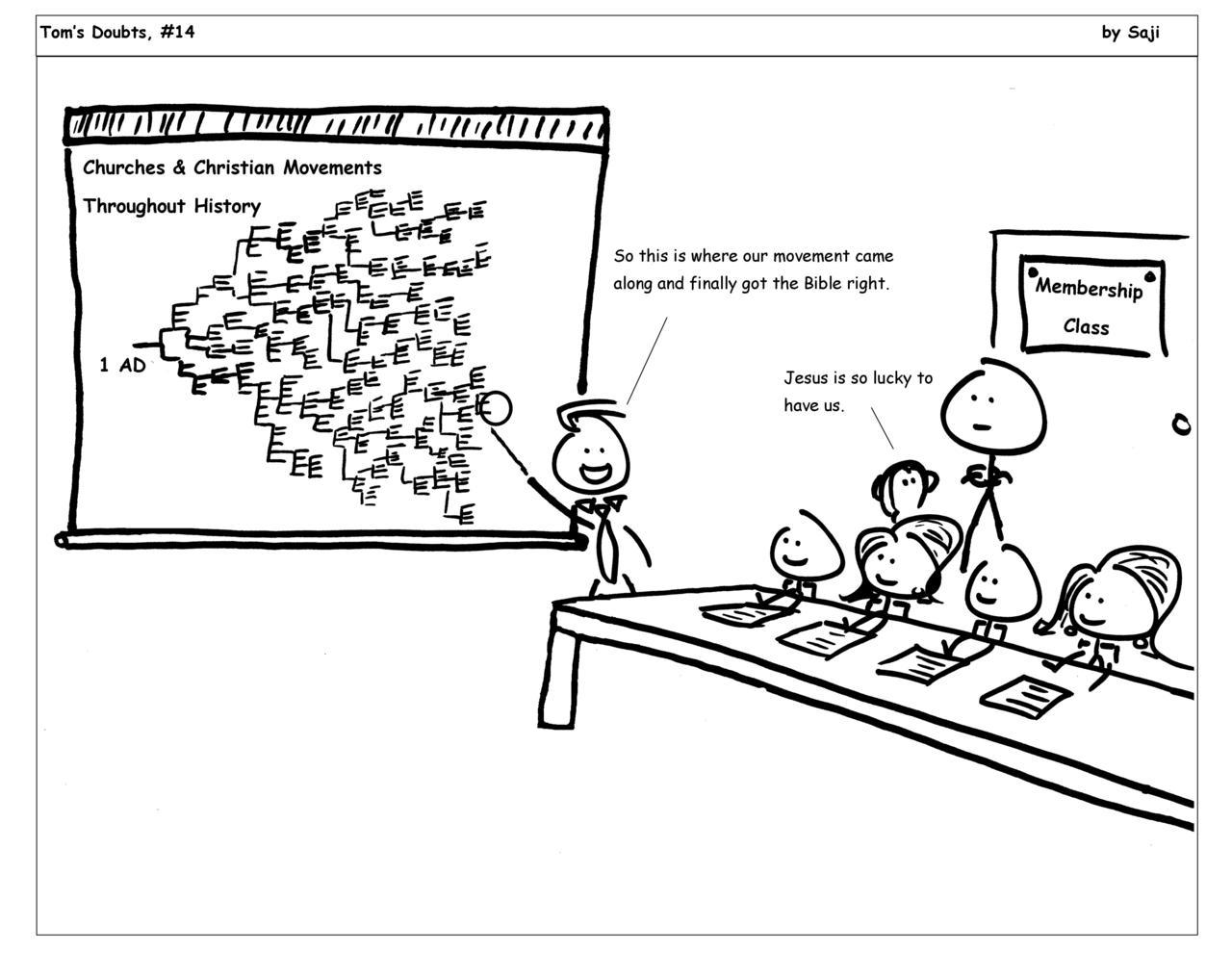
Repost: We finally Got The Bible Right


source: http://stthomasthedoubter.tumblr.com

"So this is where our movement came along and finally got the Bible right."

"Jesus is so lucky to have us"

This cartoon made me laugh, yet it should make us cry.  Being the week of prayer for Christian Unity, I hope we can recognize how wrong and arrogant an attitude like this would be.

Maybe church unity has less to do with church denominations or movements, but everything to do with the church (the people). Denominations may do a good job promoting unity on a local scale, but they may do so at the expense of creating divisions with those outside their circle.

On the other hand, if Christ's church is simply people, whenever they get together- the way church seems to be defined in the New Testament... Church unity becomes easier to recognize without the 'us vs them' mentality.

I'd love to hear your thoughts.

Related Posts:

Monday, January 20, 2014

United Prayer For Peace in Syria


I'm wondering what it would be like to be part of the minority Christian church in Syria these days.

Here are some quotes from recent news. An example of Christian unity, during the week of prayer for Christian unity.  All Christians around the world can stand with our Syrian brothers and sisters and pray for peace in Syria.

"Church leaders and representatives from Syria, the Middle East Council of Churches, the World Council of Churches and the Holy See gathered in Geneva from 15–17 January 2014 for a consultation to address the forthcoming Geneva II peace conference on Syria."
"A statement from churches around the world urging an end to the armed conflict in Syria... was presented to Lakhdar Brahimi, the United Nations-Arab League joint representative for Syria, by the World Council of Churches (WCC) general secretary Rev. Dr Olav Fykse Tveit today in Geneva, 20 January."
"Christians have maintained a continuous presence in the land of Syria since the dawn of Christianity. Today, as churches and church-related humanitarian agencies, we are present with the people of Syria on a daily basis both inside the country and amongst refugees. In this communication, we seek to raise their voice."
"As Christians we speak with one voice in calling for a just peace in Syria. To achieve this peace, we are committed to working hand-in-hand with Muslim sisters and brothers, with whom we share a common history along with spiritual and social values. We seek to work for national reconciliation and healing through building trust."
“Blessed are the peacemakers” (Matthew 5:9).

"The meeting was accompanied by an ecumenical prayer held on the evening of 16 January, also joined by the members of the international community to express their solidarity with the people of Syria, expressing hopes for peace in the country."
"The service drew attention to the great antiquity of the Christian presence in Syria, as well as the commitment of Syria's Christians, inspired by the New Testament to transform violence and oppression into healing and reconciliation."

http://www.oikoumene.org/en/press-centre/news/wcc-presents-lakhdar-brahimi-with-statement-from-churches-to-be-delivered-at-geneva-2-talks

http://www.oikoumene.org/en/press-centre/news/joint-representative-for-syria-to-deliver-urgent-call-from-churches-to-geneva-2-talks


Sunday, January 19, 2014

Evangelicals and Catholics Together

As this week is the week of prayer for Christian unity, I thought I'd share this. In 1994 a group of evangelical and Roman Catholic scholars put their names to a document affirming common beliefs and more.  As expected, there were critics on either side who did not agreed with every word put in this document. But I think it leads as an example of recognizing unity where some would not expect to find it.

Here is a short quote:

"Jesus Christ is Lord. That is the first and final affirmation that Christians make about all of reality. He is the One sent by God to be Lord and Savior of all: "And there is salvation in no one else, for there is no other name under heaven given among men by which we must be saved." (Acts 4) Christians are people ahead of time, those who proclaim now what will one day be acknowledged by all, that Jesus Christ is Lord. (Philippians 2) We affirm together that we are justified by grace through faith because of Christ. Living faith is active in love that is nothing less than the love of Christ, for we together say with Paul: "I have been crucified with Christ; it is no longer I who live, but Christ who lives in me; and the life I now live in the flesh I live by faith in the Son of God, who loved me and gave himself for me." (Galatians 2) All who accept Christ as Lord and Savior are brothers and sisters in Christ. Evangelicals and Catholics are brothers and sisters in Christ."

The full document can be found here:
http://www.leaderu.com/ftissues/ft9405/articles/mission.html

I pray that Christians would learn to recognize their brothers and sisters, and offer grace where differences seem insurmountable.

Related Post:


Saturday, January 18, 2014

Prayer for Unity

This week is the week of prayer for Christian Unity, so here is my prayer:

Dear Father, Son and Holy Spirit in heaven, I believe in your oneness. I pray that the world will see you through your children.  May your reign and rule exist here on earth in the same way as it exists in heaven.  May your will be done.  I understand that your will is that others will know you when they see you in us.

I pray against the lies of the spirit of division.  If two of your children, who have incomplete knowledge, disagree about something, they are still brothers.  It is not up to the children to decide who belongs to your family.  You do not required perfect understanding when you adopted us into your family. I pray we can accept others with the same grace you extend to us.

I've never heard of a family where the unity is based on accepting a common creed or belief system.  I pray your family would recognize that our unity is based on your loving relationship with us.  Thank you for loving us unconditionally.

You only have one church, and it meets in many different places. Many of your children have believed the lie that there are divisions in your church.  That somehow your church is a kingdom divided against itself. From Mark 3:22-30 we see that suggesting your kingdom is divided against itself is the context of the unforgivable blaspheme against the Holy Spirit.  I trust and pray that it will be that lie that falls, and not your kingdom.

I pray that your church would recognize that it exists whenever believers gather together.  I pray that the walls and divisions that have grown over the years would not influence how we define your church.  When believers meet to build each other up to become more like you, that is your church. Your church meets at work. Your church meets in homes. Your church meets in public or private buildings, and outdoors.  Your church meets every day of the week in many different locations.  I pray that your church could open it's eyes to see itself whenever and wherever it is.

I pray that your followers would recognize that unity is essential.  Scripture seems pretty clear that your followers are to love one another and not judge one another. I pray that your followers will not ignore your desire for unity.

I pray these things for the sake of others, that the world would see your characteristics of grace, love, mercy and forgiveness through your children.  May it be in line with your will. Amen.

Some verses to consider:

Jesus' Prayer for us in John 17:20 - 26 (NIV)
"My prayer is not for them alone. I pray also for those who will believe in me through their message,that all of them may be one, Father, just as you are in me and I am in you. May they also be in us so that the world may believe that you have sent me. I have given them the glory that you gave me, that they may be one as we are one: I in them and you in me. May they be brought to complete unity to let the world know that you sent me and have loved them even as you have loved me. "Father, I want those you have given me to be with me where I am, and to see my glory, the glory you have given me because you loved me before the creation of the world. "Righteous Father, though the world does not know you, I know you, and they know that you have sent me. I have made you known to them, and will continue to make you known in order that the love you have for me may be in them and that I myself may be in them."
John 13:33-35 NIV
"A new command I give you: Love one another. As I have loved you, so you must love one another. By this all men will know that you are my disciples, if you love one another." 

Colossians 3:13-15 (NIV)
Bear with each other and forgive whatever grievances you may have against one another. Forgive as the Lord forgave you. And over all these virtues put on love, which binds them all together in perfect unity.
Ephesians 4:2-6 (NIV)
Be completely humble and gentle; be patient, bearing with one another in love. Make every effort to keep the unity of the Spirit through the bond of peace. There is one body and one Spirit—just as you were called to one hope when you were called— one Lord, one faith, one baptism; one God and Father of all, who is over all and through all and in all.
Romans 15:5-7 (NIV)
May the God who gives endurance and encouragement give you a spirit of unity among yourselves as you follow Christ Jesus, so that with one heart and mouth you may glorify the God and Father of our Lord Jesus Christ. Accept one another, then, just as Christ accepted you, in order to bring praise to God.
1 Cor 12:12-13 (NIV)
The body is a unit, though it is made up of many parts; and though all its parts are many, they form one body. So it is with Christ. For we were all baptized by one Spirit into one body—whether Jews or Greeks, slave or free—and we were all given the one Spirit to drink.
1 Cor 1:10-13 (NIV)
I appeal to you, brothers, in the name of our Lord Jesus Christ, that all of you agree with one another so that there may be no divisions among you and that you may be perfectly united in mind and thought. My brothers, some from Chloe's household have informed me that there are quarrels among you. What I mean is this: One of you says, "I follow Paul"; another, "I follow Apollos"; another, "I follow Cephas"; still another, "I follow Christ."Is Christ divided? Was Paul crucified for you? Were you baptized into the name of Paul?
 Luke 6:37-38 NIV
“Do not judge, and you will not be judged. Do not condemn, and you will not be condemned. Forgive, and you will be forgiven. Give, and it will be given to you. A good measure, pressed down, shaken together and running over, will be poured into your lap. For with the measure you use, it will be measured to you."
 1 Cor 4:4-5 NIV
“It is the Lord who judges me. Therefore judge nothing before the appointed time; wait till the Lord comes. He will bring to light what is hidden in darkness and will expose the motives of men's hearts. At that time each will receive his praise from God.”
Matt 7:1-5 NIV
"Do not judge, or you too will be judged. For in the same way you judge others, you will be judged, and with the measure you use, it will be measured to you.
"Why do you look at the speck of sawdust in your brother's eye and pay no attention to the plank in your own eye? How can you say to your brother, 'Let me take the speck out of your eye,' when all the time there is a plank in your own eye? You hypocrite, first take the plank out of your own eye, and then you will see clearly to remove the speck from your brother's eye. "
1 John 4:19-21
"We love because he first loved us. If anyone says, "I love God," yet hates his brother, he is a liar. For anyone who does not love his brother, whom he has seen, cannot love God, whom he has not seen. And he has given us this command: Whoever loves God must also love his brother." 

Monday, January 6, 2014

Dogmatic Pontification

I haven't read the above book. I just stumbled upon it while considering a graphic for this post. However I'm absolutely certain it accurately addresses this topic.  I know without a shadow of a doubt Judy J. Johnson is onto something.  I know that being dogmatic about anything is absolutely wrong and very dangerous. :)

??

Unfortunately being dogmatic comes fairly natural for many of us.  (My previous paragraph included.)

according to Webster:
dogmatic: expressing personal opinions or beliefs as if they are certainly correct and cannot be doubted
I have been thinking lately about our tendency towards being dogmatic around things we believe.

I have realized something recently. I respect people that study a topic.  If you are going to voice your opinion on something it is good to study it first. My respect grows when I discover they have studied different viewpoints on the topic.  It is good to acknowledge that not everyone who has studied the topic is in agreement.

The challenging part comes next. I admire when someone is able to communicate that they see value in different perspectives on a topic, that the choice isn't necessarily crystal clear, even though they have come to rest favoring a particular position.  I am recognizing the value of approaching debatable topics with a good dose of humility.

In most situations after studying a topic, people will weigh the positions as they see them and pick a side.  This should be expected.  However when we become dogmatic about the answers we discovered, we do all we can to invalidate the fact that there were different positions to consider in the first place.  When we are dogmatic we do not allow others to study the topic freely and openly on their own.  When we acknowledge that we had to sort through some competing positions to arrive at where we currently rest, we give others permission to follow the same process we took to study the topic from different angles, in their own quest for meaningful answers.  When we avoid being dogmatic, we may even encourage them to consider our position as well.

So I have recently recognized this when listening to others. Will I be able to change and move forward applying this to how I communicate with others?  This is my challenge.  I don't know if I need to start by editing all my old blog posts, that would be a challenging activity.

Here is another angle. Since being dogmatic comes naturally for most of us, I wonder if we can consider being dogmatic about different things than we have in the past:

  • What if we were dogmatic about placing the interests of others above our own?
  • What if we were dogmatic about humbly counting others more significant than ourselves?
  • What if we were dogmatic about love, joy, peace, patience, kindness, goodness, faithfulness, gentleness, and self-control?
  • What if we were dogmatic about praying for unity and recognizing it when it stands before us?
But that is just my humble thoughts for today. There may be value in being dogmatic about other things as well. :)  

Monday, December 23, 2013

Unity Example #3 Emmanuel


I want to highlight some examples of Christian Unity. I have a few ideas to start with. If anything else comes to mind please let me know.

With Christmas approaching I want to celebrate our shared Emmanuel.

"God With Us"

Matthew 1:23 (NET)
 “Look! The virgin will conceive and give birth to a son, and they will name him Emmanuel,” which means “God with us.
When we stop and think about it, it is pretty amazing.

It is comforting to recognize that God is with us.

People have often tried to reach out to God, but we can share in the experience of God coming to be with us.

In terms of unity, we may want to stop and consider that "God is with" other Christ followers, who may be different than us, as well.

Matthew 28:20 (NET)
"teaching them to obey everything I have commanded you. And remember, I am with you always, to the end of the age.”

Please let me know if I am incorrect about most Christians sharing this.  Or if other examples of Christian unity come to mind please let me know as well. Feel free to leave any feedback. Thanks.

Sunday, December 22, 2013

Unity Example #2 Charity At Christmas


I want to highlight some examples of Christian Unity. I have a few ideas to start with. If anything else comes to mind please let me know.

With Christmas approaching I want to celebrate the shared emphasis on charity this time of year.

It seems Christians from all tradition encourage giving food, money,  or other kinds of help to people who are poor, sick, or in some form of need.

Many of the acts of charity have grown into larger charitable organizations that help connect givers with those in need. For example World Vision, Compassion, Samaritan's Purse and Operation Christmas Child, Salvation Army, local food banks and shelters for homeless... the list could go on.

I also want to highlight the simple acts of charity that Christians do individually: Giving gifts of food or clothing to someone in need. Inviting someone in need over for a meal. Helping an elderly neighbor, or someone who is sick.  It would be impossible to list all the examples of this, since much of it is done quietly and without any press coverage. 

I just want to celebrate that all Christ followers agree that Charity is a Christian thing to do, especially at Christmas.

Remember the words of the Lord Jesus, how he himself said, ‘It is more blessed to give than to receive.’   Acts 20:35

Saturday, December 21, 2013

Unity Example #1 Peace At Christmas

I want to highlight some examples of Christian Unity. I have a few ideas to start with. If anything else comes to mind please let me know.

With Christmas approaching I want to celebrate the shared emphasis on peace this time of year.

A saying goes:

Three phrases that sum up Christmas are: Peace on Earth, Goodwill to Men, and Batteries not Included.

Christians from various traditions encourage peace at Christmas.  The first example that comes to mind are examples of Christmas truces during bloody wars.  It seems very strange that men will be trying to kill each for months or years, but then when Christmas day arrives they have often made peace for the day. I found this fascinating story where German and Allied soldiers met in 'no man's land' during World War 1 to shake hands and wish each other Merry Christmas: http://history1900s.about.com/od/1910s/a/christmastruce.htm

I think the shared emphasis of Peace at this time of year originates from the lips of the angels in this passage.

Luke 2:10 - 14 (NET)
But the angel said to them, “Do not be afraid! Listen carefully, for I proclaim to you good news that brings great joy to all the people: Today your Savior is born in the city of David. He is Christ the Lord.  This will be a sign for you: You will find a baby wrapped in strips of cloth and lying in a manger.”  Suddenly a vast, heavenly army appeared with the angel, praising God and saying,  “Glory to God in the highest, and on earth peace among people with whom he is pleased!”

Christians believe Christ is a source of peace.

May we recognize that all Christ followers desire peace (at least at Christmas). 

May we all find Peace during this Christmas season, and once we find it may we hold it all year long.

May we consider how we can work together to bring peace to each other here on earth.

John 14:27 (NET)
“Peace I leave with you; my peace I give to you; I do not give it to you as the world does. Do not let your hearts be distressed or lacking in courage."

If any other examples of Christian unity come to mind, please let me know.

Peace Out!

Saturday, June 8, 2013

Taking a Break


My spiritual journey is going off the public airwaves for awhile.  I need to take a break from speaking out on topics, and simply live my faith for awhile.  But I want to summarize some of the topics that have come together for me lately.

Jesus' Gospel vs Paul's Gospel: I believe both Jesus and Paul preached a Jesus centered gospel.  Jesus preached Jesus, and Paul preached Jesus.  Both proclaimed that Jesus was Christ, messiah, king, savior, and Lord. 

What Must I Believe (a 6 part series): Looking at Scripture passages related to what we must do or believe to be saved, it seems we must place our trust in the person of Jesus.

Unity is Essential : This has been my starting point on this journey.  I recognize a value for theological discussions when it leads people to mature in their relationship with Christ. Unfortunately if we focus too much on correct theology and take our focus off our relationships with the person of Christ, we often recognize we are not united in our different sets of essential beliefs.   I suggest a solution is placing Christ central, and elevating Him above our different understandings about Him.

My Role with Church: Church is people, followers of Christ and whenever they get together. Period (see Church Etymology).  Scripture teaches that we are to meet together with the purpose of building each other up to become more like Christ. It makes sense that we practice the One Anothers (another 6 part series) when we get together. 

Love is Essential: It is the greatest commandment.  The greatest of these is love. If I don't have love, I have nothing, all of this is pointless. God's love working though us helps others recognize we are disciples of Christ. If there is one command of Jesus I want to get right, it is this one.


Wednesday, May 22, 2013

What Creed Must I believe - Part 6

This is part six of a series exploring the question: "What set of beliefs do all true Christ followers believe?"

Please read some of these other posts first:

What Must I Believe Part 1 - explanation and look at Acts 16:30 - 31
What Must I Believe Part 2 - where Jesus tells a woman she is saved
What Must I believe Part 3 - a look at John 3:16
What Beliefs Part 4 - Whom Do I Trust?
What Must I believe - Part 5 - more verses to consider
What Creed Must I believe - Part 6 - how creeds can divide

The Bible was not written in the form of a creed or catechism.  The previous posts in this series have noted that there is no list of essential beliefs attached to passages related to what we must believe or trust to be saved.  I am concluding that it is trusting in the person of Jesus that is essential, not trusting in a correct set of beliefs about Jesus.

However as Christianity evolved, it didn't take long for creeds and catechisms to become popular.

The well known Apostle's creed is one of the first such lists:
"I believe in God, the Father almighty,creator of heaven and earth.
I believe in Jesus Christ, God's only Son, our Lord, who was conceived by the Holy Spirit, born of the virgin Mary, suffered under Pontius Pilate, was crucified, died and was buried; he descended to the dead. On the third day he rose again; he ascended into heaven, he is seated at the right hand of the Father, and he will come to judge the living and the dead. I believe in the Holy Spirit, the holy catholic Church, the communion of saints, the forgiveness of sins, the resurrection of the body, and the life everlasting. Amen "


This is a great list of shared beliefs.  In fact most Christian denominations accept this creed as part of their beliefs.  I love it.

But for many, this creed does not go far enough.  For example the Apostle's creed didn't speak about equality between the Son and the Father.  So the Nicene creed was formed to define the orthodox position on that issue. So accepting the truths in the Apostle's creed was not enough to be considered a true believer.

Next came the Athanasian creed which included beliefs about the trinity.

For many Christians today these creeds are still not enough. For example they do not address how God deals with the sin problem through the work of the cross, or how we are justified by faith.

Over time larger catechisms were created to address many more issues.


Although I wish we could use something like the Apostle's creed as a measuring stick to say who is in and who is out, I don't see the writers of Scripture doing that.  It seems they consistently equate trusting in the person of Jesus as the source of one's salvation.

Unfortunately what has happened throughout church history is that Christians have divided over these distinct lists of essential beliefs.  Instead of recognizing that we are united around trusting the person of Christ, we have recognized we are not united in our different sets of essential beliefs. I see this as a huge problem.  Scripture is clear unity is essential.  I suggest a solution is placing Christ central, and elevating Him above our different understandings about Him.

I'd love to hear your thoughts.

Related Posts:

Saturday, May 18, 2013

What Must I believe - Part 5

This is part five of a series exploring the question: "What set of beliefs do all true Christ followers believe?"

Please read some of these other posts first:


What Must I Believe Part 1 - explanation and look at Acts 16:30 - 31
What Must I Believe Part 2 - where Jesus tells a woman she is saved
What Must I believe Part 3 - a look at John 3:16
What Beliefs Part 4 - Whom Do I Trust?
What Must I believe - Part 5 - more verses to consider
What Creed Must I believe - Part 6 - how creeds can divide

In previous posts I have been looking for passages which tell us a set of information that we we must believe to be saved.  I haven't found such a list.  I am thinking then it is not so much a list of essential beliefs about Jesus we must place our trust in. Salvation comes instead by placing our trust in the person of Christ.

I'd like to test this thought with a few more verses. As you read each question ask:

Does this passage answer the question: "What information must I believe?"  

Or does this passage answer the question: "What person must I trust?"

Note in some cases I am going with the term trust  instead of believe or faith - where it seems to fit with the greek.

"Yet to all who did receive him, to those who trust in his name, he gave the right to become children of God— John 1:12

"The one who trusts in the Son has eternal life. The one who rejects the Son will not see life, but God’s wrath remains on him." John 3:36/NET

“Very truly I tell you, whoever hears my word and trusts him who sent me has eternal life and will not be judged but has crossed over from death to life." John 5:24 (NIV)

For this is the will of my Father – for everyone who looks on the Son and trusts in him to have eternal life, and I will raise him up at the last day.” John 6:40/NET

"I am the door. If anyone enters through me, he will be saved, and will come in and go out, and find pasture." John 10:9/NET
"For everyone who calls on the name of the Lord will be saved." Rom 10:13/NET
"And then everyone who calls on the name of the Lord will be saved. ’ Act 2:21/NET

Exceptions:

The following passages do not really support my idea that trust in the person of Christ is what brings salvation. But they also don't support the idea that belief in a specific list of information about God does either. (unless you are fine with the really short list in Rom 10:9)
"because if you confess with your mouth that Jesus is Lord and believe in your heart that God raised him from the dead, you will be saved." Rom 10:9/NET

"The one who eats my flesh and drinks my blood has eternal life, and I will raise him up on the last day." John 6:54/NET

"eternal life to those who by perseverance in good works seek glory and honor and immortality," Rom 2:7/NET


In the next post I'll take a quick look at some of the early creeds or lists of beliefs.

In the meantime, I'd love to hear your thoughts.  Have I missed any passages that would help us understand what beliefs are necessary for salvation?


Thursday, May 16, 2013

What Beliefs Part 4 - Whom Do I Trust?

This is part four of a series exploring the question: "What set of beliefs do all true Christ followers believe?"

Please read some of these other posts first:


What Must I Believe Part 1 - explanation and look at Acts 16:30 - 31
What Must I Believe Part 2 - where Jesus tells a woman she is saved
What Must I believe Part 3 - a look at John 3:16
What Beliefs Part 4 - Whom Do I Trust?
What Must I believe - Part 5 - more verses to consider
What Creed Must I believe - Part 6 - how creeds can divide

Yes, I'm playing with what we mean by words again. Please humour me as I find it helpful.   The way we use the terms believe and trust may impact how we read the passages I've looked at so far.

I believe in parachutes. I believe in the science behind them. I even have faith that they work (most of the time).   But I have never placed my trust in a parachute, and have no plans to trust a parachute with my life.

Or take this random fact for example:
"If you have 3 quarters, 4 dimes, and 4 pennies, you have $1.19. You also have the largest amount of money in coins without being able to make change for a dollar. "

(Canadians: just try to remember back to the days when we had pennies.)

Yes I believe this information. The math looks good. Do I place any trust in this statement? No. So far in my life this random fact has made little to no difference in my life.  I don't see the need to place any trust in this information.

Believing that information is correct can be different than placing trust in something.

Up to this point I have been looking at different passages of Scripture for a list of essential beliefs about Jesus that believers must believe to be 'saved'. So far I haven't been able to find such a list.  So I am leaning towards assuming saving faith isn't about faith in a correct set of doctrines or truth statements about God and Jesus.  I am thinking the object of our saving faith is something other than correct information.

When Jesus and others say we must "believe in Jesus" to be saved, they didn't say "believe the following about Jesus".

The greek terms for believe and faith in the previous passages can also be translated trust, or to have trust in.
http://biblesuite.com/greek/4102.htm
http://biblesuite.com/greek/4100.htm

So what happens if we substitute the terms belief or faith with trust?

We get statements like this:

  • Jesus said to the woman, “Your trust [in me] has saved you; go in peace.”
  • "He gave his one and only Son, so that everyone who trusts in him will not perish but have eternal life."
  • “Trust in the Lord Jesus, and you will be saved—you and your household.”

Since none of the passages state "to be saved you must believe the following information or truth statements about Jesus", I think it makes sense to assume the object of our trust is in the person of Jesus.

It is not trusting in correct theology, but trusting in the source of truth Himself.

We see in James 2:19 that simply believing correct information about God does not count.  The demons likely have better understanding of theology that most of us.  The concern for them is where/whom they place their trust.
"You believe that God is one; well and good. Even the demons believe that—and tremble with fear." (NET)

Obviously there is great value in having accurate theology.  If you are serious about following Jesus, you will want to understand Him better.  But the evidence of Scripture is leaning in favour of salvation based on trusting in the person of Christ, over trusting in some specific teachings about Christ.

I will continue this series with a list of other passages I have looked at.  If you want me to include a specific passage please let me know in a comment.

Please share your thoughts on this.


Wednesday, May 15, 2013

What Must I believe Part 3

This is part three of a series exploring the question: "What set of beliefs do all true Christ followers believe?"

This post may make more sense if you read some of these first:


What Must I Believe Part 1 - explanation and look at Acts 16:30 - 31
What Must I Believe Part 2 - where Jesus tells a woman she is saved
What Must I believe Part 3 - a look at John 3:16
What Beliefs Part 4 - Whom Do I Trust?
What Must I believe - Part 5 - more verses to consider
What Creed Must I believe - Part 6 - how creeds can divide

Next I'd like to look at one of the most popular verses in the Bible - John 3:16.  Let's look at a few verses around it too. John 3:14 - 21 (NIV)
"Just as Moses lifted up the serpent in the wilderness, so must the Son of Man be lifted up, so that everyone who believes in him may have eternal life.”  For this is the way God loved the world: He gave his one and only Son, so that everyone who believes in him will not perish but have eternal life.  For God did not send his Son into the world to condemn the world, but that the world should be saved through him. The one who believes in him is not condemned. The one who does not believe has been condemned already, because he has not believed in the name of the one and only Son of God. Now this is the basis for judging: that the light has come into the world and people loved the darkness rather than the light, because their deeds were evil. For everyone who does evil deeds hates the light and does not come to the light, so that their deeds will not be exposed.  But the one who practices the truth comes to the light, so that it may be plainly evident that his deeds have been done in God.
In this passage Jesus simply teaches that everyone who believes in Jesus, and believes in the name of Jesus, will have eternal life.  Seems simple enough.

But like the previous passages I looked at, Jesus does not list how much information about Himself we must believe.  Do we need to understand and believe all that He has done for us in the past, and all He is doing in the world today, and the how and why he does it? He doesn't say we have to understand original sin, where sin will lead us, the work of the cross, justification, sanctification, His mercy, or grace.  I'm starting to suspect salvation isn't based on how much information we believe about Jesus.  If it was, it would have been nice if Jesus had mentioned here what information we need to believe.

However,  on the other hand, is it simply enough to say we believe in Jesus, and live however we please? No.

This passage gives the basis for judging who truly believes. Note that the evidence of true faith is not about how accurate their belief system is.  It looks like it is based on having fruit.   The passage doesn't say we are saved by doing good deeds, but it does say good deeds will be evident if we are saved. Those who follow Christ will become transformed to become more like the one they are following.

I am starting to get some clarity on this topic, I hope it makes some sense to others as well. If salvation is based on agreement with a list of truth statements about Jesus, why don't we see Jesus providing such a list here or elsewhere.  If it is not about belief in some information, what are we to be placing our trust in?

I plan to look at a few more passages soon.  If you have any passages you want to suggest I include in this series please leave them in a comment.

I'd love to hear your thoughts.


Monday, May 13, 2013

What Must I Believe Part 2

This is part two of a series exploring the question: "What set of beliefs do all true Christ followers believe?"

This post may make more sense if you read these too:


What Must I Believe Part 1 - explanation and look at Acts 16:30 - 31
What Must I Believe Part 2 - where Jesus tells a woman she is saved
What Must I believe Part 3 - a look at John 3:16
What Beliefs Part 4 - Whom Do I Trust?
What Must I believe - Part 5 - more verses to consider
What Creed Must I believe - Part 6 - how creeds can divide

Next lets look at a passage in Luke 7:36 - 50 where Jesus is anointed by a sinful woman:
"When one of the Pharisees invited Jesus to have dinner with him, he went to the Pharisee’s house and reclined at the table. A woman in that town who lived a sinful life learned that Jesus was eating at the Pharisee’s house, so she came there with an alabaster jar of perfume. As she stood behind him at his feet weeping, she began to wet his feet with her tears. Then she wiped them with her hair, kissed them and poured perfume on them.

skip to verse 47 

(Jesus said) "Therefore, I tell you, her many sins have been forgiven—as her great love has shown. But whoever has been forgiven little loves little.”  Then Jesus said to her, “Your sins are forgiven.”  The other guests began to say among themselves, “Who is this who even forgives sins?” Jesus said to the woman, “Your faith has saved you; go in peace.”  (NIV)

Like the last story, it may seem some things are missing from this story.  The story doesn't mention any gospel presentation. It doesn't mention Jesus going through a list of beliefs that must be accepted by faith.  There is no sinners prayer mentioned.

However it does mention her sins being forgiven, and that she is saved by faith.

Faith in what is the key question?  Is it faith in a set of information? Is it agreement in some truth statements?

If it was her belief in a set of information that has saved her, it would have been nice if Jesus had mentioned that.  But just like the previous example in Acts 16 no list of essential beliefs is given.

I have an idea of what the object of her faith may have been.  But first I'll look at a few more passages.

I'd love to hear your thoughts.

Saturday, May 11, 2013

What Must I Believe Part 1

What set of beliefs do all true Christ followers believe?

Christians believe all sorts of different things.  Is there a minimum amount of information a Christ follower needs to accept as truth by faith to be saved? Many Christians over the years have developed catechisms and statements of faith in an attempt to address this question. 

If someone asked you the question "What must I do to be saved?"  How would you respond?  Is there a set of information that you would want to go through to explain the basics of the faith?  Is there a list of verses that you would flip through to point out the most important beliefs?

To explore this question I would like to do a series of posts. There are a number of passages in New Testament that speak about what needs to occur to be saved.

The passage in Acts 16 comes to mind first where a jail guard asks Paul and Silas this key question:

 “Sirs, what must I do to be saved?” 

They replied, “Believe in the Lord Jesus, and you will be saved—you and your household.” 

From this text, what set of information must be believed to be saved?  

Does it say we need to believe that God is Holy? That we are sinners?  That God cannot be in the presence of sin so Jesus paid our debt on the cross so we can be with Him?

What about information about the Trinity? What about the resurrection? What about God's love? What about the role of the Holy Spirit? We could go on and on and create a lengthy catechism.

This passage does go on to say "they spoke the word of the Lord to him and to all the others in his house."  We can only guess as to what that sounded like.   I can imagine it including some of  what I just mentioned above.  But we don't know how much.

We must also note the passage doesn't say "Believe the following about the Lord Jesus and you will be saved".  There is a difference between trusting someone, and believing information about someone. Getting the information about Jesus correct does matter for many different reasons.  I would not encourage anyone to embrace doctrines they know are false.  But how much of the information needs to be understood correctly for salvation?  That is the question I would like to explore further.


Here are other posts in this series:


What Must I Believe Part 1 - explanation and look at Acts 16:30 - 31
What Must I Believe Part 2 - where Jesus tells a woman she is saved
What Must I believe Part 3 - a look at John 3:16
What Beliefs Part 4 - Whom Do I Trust?
What Must I believe - Part 5 - more verses to consider
What Creed Must I believe - Part 6 - how creeds can divide

I'd love to hear your thoughts.

Saturday, February 2, 2013

Do You Know Your Lusts of the Flesh

When you think about lusts of the flesh what do you think of?  I believe Galatians 5:16 - 21 has a list of different lusts of the flesh . I suspect we often reduce this list and ignore a few.

I'll start with the good old King James version since it translates epithymian as lust.  Side note: this Greek term often gets translated as desire, for example Jesus desired (or lusted) to eat passover in Luke 22:15.

Galatians 5:16 - 21 (KJV)
"This I say then, Walk in the Spirit, and ye shall not fulfil the lust of the flesh. For the flesh lusteth against the Spirit, and the Spirit against the flesh: and these are contrary the one to the other: so that ye cannot do the things that ye would. But if ye be led of the Spirit, ye are not under the law. Now the works of the flesh are manifest, which are these; Adultery, fornication, uncleanness, lasciviousness, Idolatry, witchcraft, hatred, variance, emulations, wrath, strife, seditions, heresies, envyings, murders, drunkenness, revellings, and such like: of the which I tell you before, as I have also told you in time past, that they which do such things shall not inherit the kingdom of God."

OK, there is quite the list here of desires or lusts of the flesh - things that are contrary to the fruit of the Spirit that are listed next in the popular Gal 5:22 - 23.

I want to highlight one that often gets overlooked when we think about lusts of the flesh.

In the KJV list we see listed heresies - from the greek haireseis.

Other translations go with terms like factions, divisions, sects, or schools of opinion in Gal 5:20. 


SECTS is a naughty lust of the flesh. 

I dare you to speak this truth the next time you are with a bunch of Christians.  Then spell it out because I'm pretty sure you'll be misunderstood. :)

We have a natural human tendency to be divisive.  A simple look at church history and the 40,000+ Christian denominations, sects and factions is proof enough.  This is not the work of the Spirit - it is contrary to the fruit of the Spirit which includes love, peace, patience, and meekness.

Related Posts: